
An unplanned autobiography exists for most of us. A large amount of email, text messaging, group chat, work-related communication, and late-night responses exists in archived files that are infrequently accessed. Altogether, these contain millions of words written in your voice, containing information regarding your humor, concerns, behaviors, and interpersonal relationships.
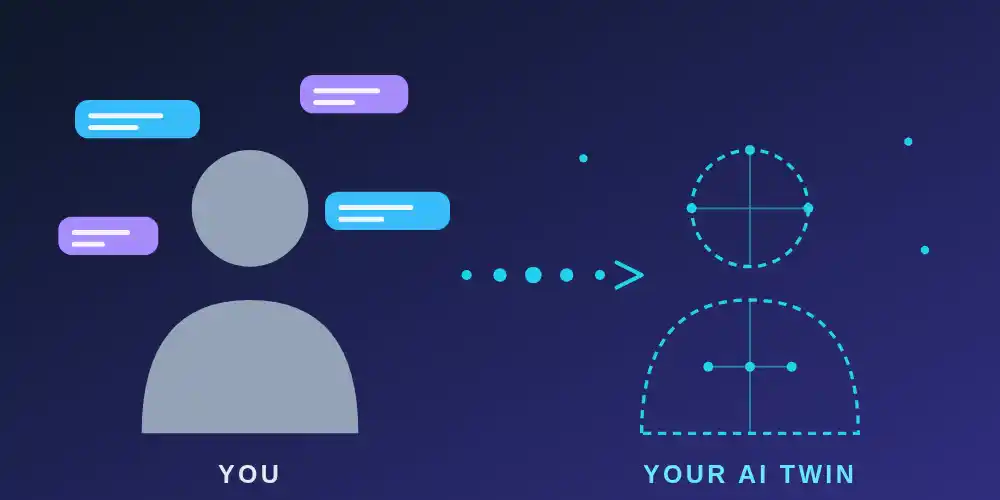
Prior to recently, there was little that could be done with this mass of data. With the advent of AI, it can analyze all of this in a matter of seconds, which leads to an unpleasant query: Can an AI review your prior communications and recreate a being that communicates, reacts, and makes decisions as you would?
In general terms, an AI has the ability to replicate some of what you are asking for (and its abilities are rapidly improving). It can emulate your tone/writing style, can even forecast how you will respond, and provide an estimation of what you think about subjects you have discussed.
However, as of right now, an AI cannot fully reflect the person who created the text. This is precisely where much of the most intriguing science and difficult ethics issues exist today.
Table of Contents
What Your Messages Actually Reveal
The extent to which someone’s personality affects the way they communicate via email, text message, etc., is generally underestimated. Researchers in stylometry (the statistical analysis of writing style) have been able to identify authors of written materials based upon a multitude of subtle characteristics.
Such as how frequently they utilize commas, what types of filler words they prefer, how long their sentences are, and whether they write “okay”, “ok,” or “k”. Because these characteristics are extremely difficult to mimic and remain remarkably consistent throughout an author’s lifetime, it makes identifying authors possible.
The way you communicate goes beyond mere style; your messages provide insight into your interests, the people you converse with the most, how you manage disagreements, and how you adjust your tone based upon who you’re speaking to.
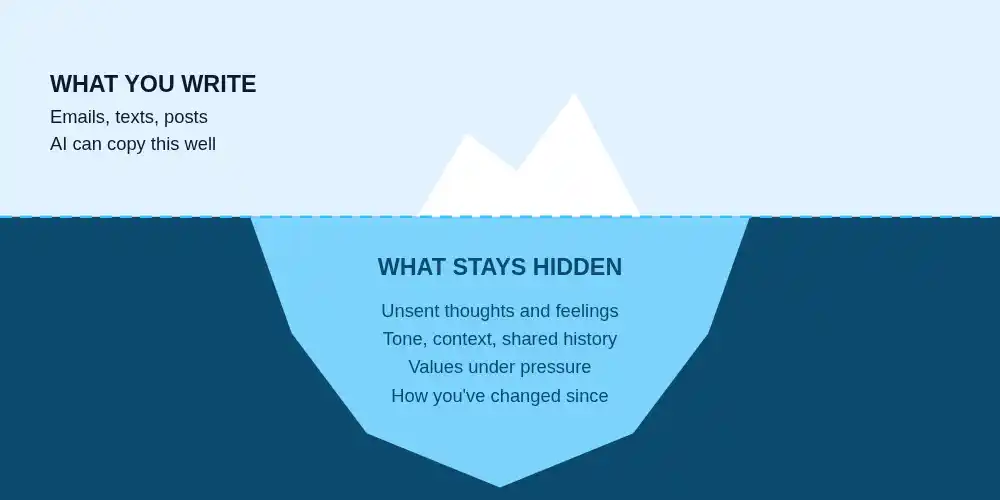
For example, it’s likely that you will be direct with your sibling, professional with your client, and light-hearted with an old friend. An extensive archive will document each of these styles, as personality isn’t simply one voice, but rather a collection of consistent patterns of behavior in various circumstances.
Digital traces (such as the digital signals left behind as you browse the web or interact with social media) provide information about you.
One particularly notable example of psychological research on the topic is the work of Michal Kosinski and his co-workers, which showed that a machine-learning algorithm trained on Facebook “likes” can accurately predict your Big Five personality traits at a higher rate of accuracy than can those close to you, such as your friends and family.
However, for this to occur, the algorithm requires sufficient training data. There is also a body of research demonstrating that language used in communication correlates with various personality characteristics, including extraversion, anxiety, and openness. However, none of these findings suggest that your emails are a complete reflection of who you are. Rather, they represent a legitimate signal about you, and artificial intelligence is capable of extracting signals from large volumes of text.
How The Technology Would Work
There are two basic ways that you can use the data you have collected from your messages to create a “you,” but these methods will produce extremely different results.
The first technique for adapting the model to yourself is called “fine-tuning.” This means taking an already trained model and continuing to train it using your own writings. As long as you continue to train the model, it will begin to produce responses that are similar to how you write, in terms of your vocabulary, rhythm, and other writing styles.
This is the best technique for producing a response that sounds like you. Your model will use words and phrases that you would typically use. It will also typically open and close emails in the same manner as you. However, this is not the most effective technique for producing a response that contains accurate information about your life. This is because your model learns through pattern recognition, not through memorization.
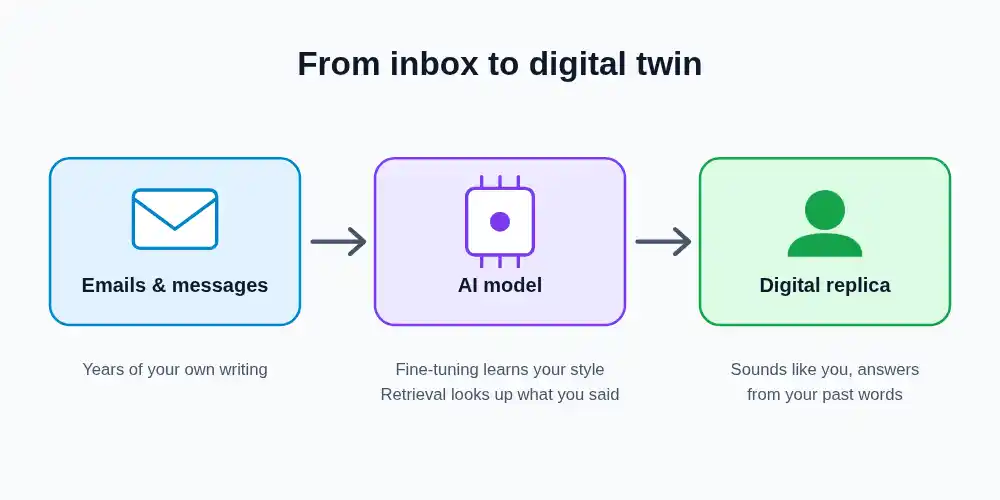
The second method of incorporating your past into the AI is “Retrieval.” You create an index of all of your previous writings (your “archive”), and each time the AI responds, it searches that index for content related to your question. For instance, if you ask the AI what you think about relocating to another city, it would pull up all of the conversations you had about this topic during the last ten years, and use those to craft a response based on what you previously expressed.
Retrieval is much more effective than the previous method at identifying factual information, dates, and specifically what you stated in your previous communications. Additionally, the process of updating the AI’s knowledge base using the Retrieval approach is simpler as well, since it can be done simply by adding new writing to your archive.
The best models integrate both components by providing a personal description of yourself which includes your values, relationships, and communication styles. Additionally, some models will maintain an active memory, allowing the replica to continue the conversation based upon prior interactions. At this point, none of the above is considered to be “exotic.” Tools to accomplish the above are available. However, the primary limitation is the quality of the data and the ability of the model to utilize reasoning to derive knowledge from said data.
An important aspect to consider is that the wider the variety of material in your archive, the better the final product. Your professional persona will be formed by your ten years of emails from work. However, if you include personal messages, voice notes, journals, and social media postings, the replica will have a broader scope. A single context produces a caricature; however, multiple contexts produce something more like a person.
What The Research Says So Far
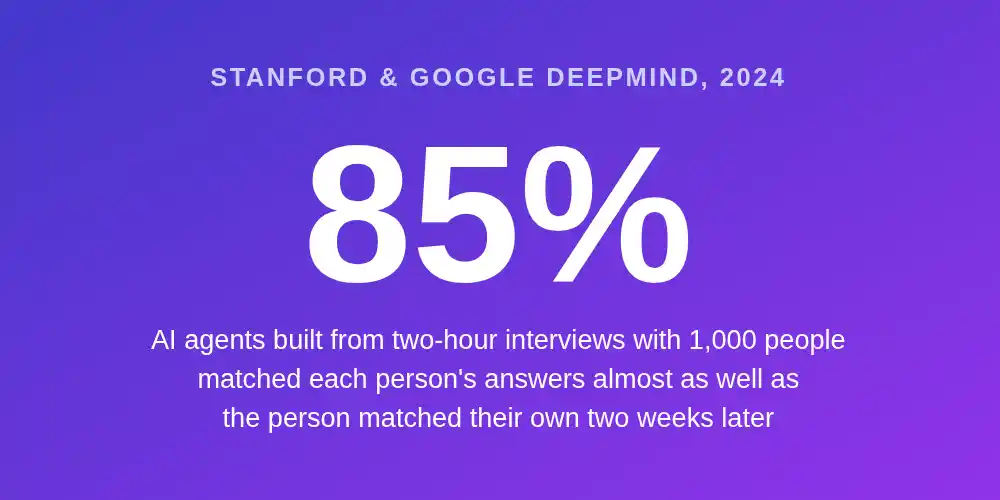
The evidence that AI can simulate individuals is far greater than what many people anticipate. Researchers from Stanford and Google DeepMind conducted a study in 2024. During this study, researchers interviewed approximately 1,000 individuals for roughly two hours per individual. Researchers then used the transcriptions of these interviews to develop AI agents. During surveys and behavioral experiments, the AI agents responded to questions similarly to the way their human counterparts did.
On average, the AI agents responded to questions approximately 85% as consistently with their human counterparts as their human counterparts responded to questions consistently with themselves two weeks later. Thus, the AI agents were nearly as reliable as the humans themselves when responding to questions over time. These results are remarkable given that the data used by researchers was collected through interviews and not through several years of private messaging, suggesting that a larger collection of data may yield even greater amounts of information.
In addition to these, there have been earlier, more personal projects. For instance, in 2015 Eugenia Kuyda (founder of Replika) created a chatbot based upon thousands of text messages sent to her by her close friend Roman Mazurenko, prior to his death. His friends stated that the chatbot was able to mimic his speech patterns to such an extent that it could provide comfort and create discomfort. It is believed that this project has led to the creation of a number of other “grief tech” products that offer to create chatbots or voice avatars for deceased loved ones.
AI does a great job of mimicking the way people speak and the things people typically talk about in previous conversations. Replicas are most effective when surveying, having short conversations, and casually chatting. There is no evidence to suggest that AI is effective in dealing with new experiences, making major life choices, or anything the person has never verbalized.
The Risks And Ethical Questions
This capability may help families cope with their grief, but it can also be used maliciously. There are numerous factors to take into account prior to the technology being widely adopted.
Consent
You will use other people’s messages to train your replica. All emails have some form of other people’s words, secrets, or other information. If you use this information to train your replica, it will expose the other people, usually without them knowing. While data protection laws (such as the GDPR) provide rights for individuals to protect their own personal data, they did not consider “personality cloning,” so there are no clear ways to enforce those rights.
Impersonation and Fraud
If a model writes similar to you, then the model can also write messages under your name. There have been several voice cloning scams where people were tricked into sending money to someone they believed was a family member. By adding a text-based persona that understands your routine and your friends, phishing will be much easier to pull off. Anyone with access to your archives (via hacking, leaked backups, or former employers) will have an extremely useful resource.
Use of Deadbots
Researchers at the University of Cambridge have warned about “deadbots” (AI representations of people who have died) and recommended safeguards including getting the user’s permission prior to death; setting age limits on deadbot usage; and creating mechanisms for users to delete their replicas. Among other issues, researchers worry about users becoming emotionally dependent upon deadbots; receiving unwanted advertisements using the voice of their lost loved ones; and experiencing distress when they cannot say goodbye. Deadbots do not provide solutions to grief, and for many users, they can actually prolong the suffering associated with grief.
Employers and institutions
Since the law is silent about this area, it would be easy to believe that an employer could use the emails from a former employee’s work message archive to train a machine learning model to help maintain the employee’s institutional knowledge. Whether or not using emails as a means to maintain institutional knowledge is the most effective approach to preserving expertise, or if it violates the former employee’s right to privacy, is open to debate. Different employees may view this issue in different ways.
Misrepresentation
A replica has the potential to make statements that you didn’t actually make and would never make, and since it is based on your voice, others may believe that the statement came from you. If your digital twin makes a promise, offers advice, or offends someone, who will be held accountable for those actions? At present, there are very few legal frameworks in place to address these issues.
The psychological effects. Using a version of yourself as a self-reflective tool can help you identify trends in your thinking. At the same time, using a version of yourself as a decision-maker for you (outsourcing) will likely result in a confirmation bias since the model will reflect what you already believe.
What You Can Do Now
Do not wait until the technology matures to start thinking about this. Think about who has access to your emails and message history and for how long it will be stored. Review the privacy settings for messaging applications and cloud backup services. Think carefully about whether to upload your archive to a third-party service, as your data could be stored and used in ways you did not intend. If you wish to preserve or delete your messages after death, then make sure to put those wishes in writing, as few people have ever put down their wishes regarding this. Also, don’t forget that the other people in your conversations also have an interest.